How ambiguous user stories silently drain time, money, and team morale — and what you can do about it.
The Definition Dilemma
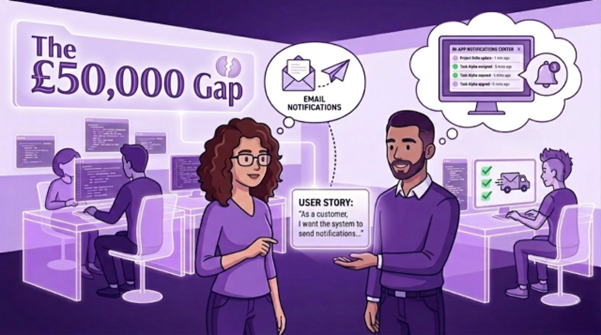
A developer receives a user story from a business stakeholder:
“As a customer, I want the system to send notifications so that I stay updated on project changes.”
At first glance, the request seems straightforward.
The developer assumes this usually means email notifications whenever a project is updated. Over the next two weeks, the team builds a notification service, integrates it with the email provider, and adds templates for different project updates.
The QA team creates test cases to validate that emails are triggered correctly when project changes occur.
During the sprint review, the stakeholder looks puzzled.
“What about in-app notifications?” they ask.
After speaking with customer teams, the stakeholder explains that users expected real-time notifications inside the application, not emails. Many customers rarely check email but actively use the dashboard.
The feature technically works, but it doesn’t solve the problem.
The team now needs to build an in-app notification system, redesign parts of the UI, and create new event triggers.
What looked like a completed story suddenly becomes two more sprints of rework.
The team built a mail delivery system.
The users needed a notification center.
What the User Story Should Have Looked Like
The original story looked like this:
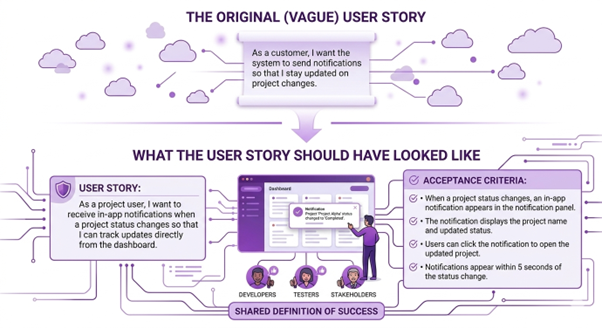
As a customer, I want the system to send notifications so that I stay updated on project changes.
But the real requirement was more specific.
A clearer user story might have been written like this:
User Story
As a project user, I want to receive in-app notifications when a project status changes so that I can track updates directly from the dashboard.
Acceptance Criteria
- When a project status changes, an in-app notification appears in the notification panel.
- The notification displays the project name and updated status.
- Users can click the notification to open the updated project.
- Notifications appear within 5 seconds of the status change.
With this level of clarity, developers, testers, and stakeholders share the same definition of success.
Six Sprints of Silent Waste
Ambiguous user stories rarely fail loudly. Instead, they quietly drain time, energy, and focus from teams.
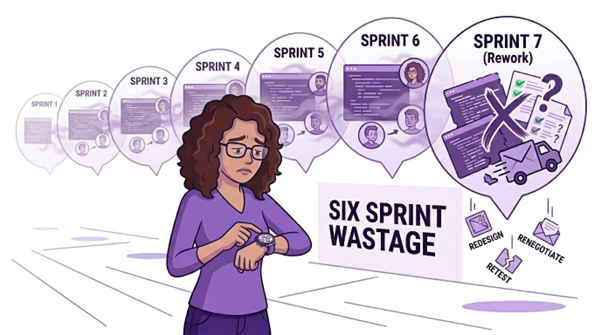
At first, everything looks normal. The story is picked up during sprint planning, development begins, and progress is visible on the board. The team believes they are moving forward.
But ambiguity has a way of revealing itself late.
A stakeholder review introduces new interpretations. QA discovers gaps in expected behavior. Developers realize that the feature technically works but doesn’t meet the intended outcome.
Suddenly, a story that was considered “done” returns to the backlog.
Small misunderstandings begin to compound:
- Test cases must be rewritten because acceptance criteria were unclear.
- A feature needs redesign because user expectations were different.
- Developers revisit code they thought was complete.
- Product managers must renegotiate timelines with stakeholders.
One ambiguous requirement can quietly consume multiple sprints of effort.
Not because teams are inefficient, but because the problem itself was never clearly defined.
In agile teams, velocity often slows not because of technical challenges, but because of uncertain definitions of success.
The Maths of Misunderstanding
When ambiguous user stories go wrong, we often talk about wasted time.
But the financial reality is much harsher.
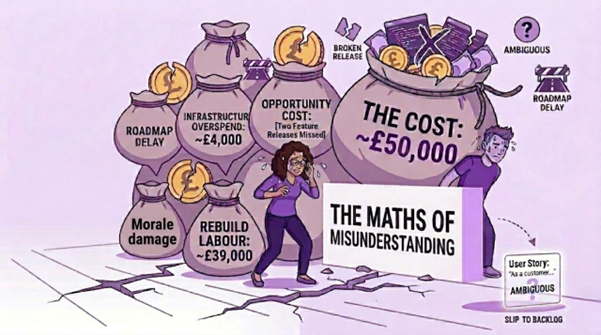
Let’s look at a simple example.
Two developers, a tester and a designer spend two weeks building a feature based on an unclear requirement. When the misunderstanding surfaces, the team has to rebuild the solution.
The rebuild cost alone quickly adds up.
- Rebuild Labour: ~£39,000
- Infrastructure Overspend: ~£4,000 (temporary services, environments, tooling)
But those are just the visible costs.
The hidden costs are often much larger.
- Opportunity Cost: The team misses two planned feature releases while fixing the mistake.
- Roadmap Delay: Stakeholders must push timelines further out.
- Morale Damage: Developers see weeks of work discarded.
By the time you account for lost roadmap momentum and team frustration, a single ambiguous user story can quietly turn into a £50,000 mistake.
All because a vague requirement slipped into the backlog disguised as a normal user story.
Why Human Eyes Miss the Gap
Why did nobody catch it earlier?
Because everyone believed they already understood the requirement.
The product manager thought they understood the stakeholder.
The developer thought they understood the product manager.
The QA team assumed the acceptance criteria captured the intent.
Everyone was working from their own internal dictionary.
This is the hidden danger of requirements to user stories translations. We assume that because we are using the same words, we are sharing the same vision.
In a typical two-week sprint, a team might process up to 6 or 7-user stories. If each story has five or six acceptance criteria the potential point of failure is multifold.
Most of those assumptions go unnoticed, until the feature is built.
The Power of Shift Left
So how do teams prevent these misunderstandings before they turn into expensive rework?
The answer lies in a principle many engineering teams already know well: shift left.
Shifting left means moving quality checks earlier in the development process, long before code is written.
Instead of discovering gaps during sprint reviews or production releases, teams identify them while requirements are still being defined.
In the story we saw earlier, a simple review of the user story could have surfaced the ambiguity in the phrase “notifications.”
Was the expectation about:
- page latency,
- data refresh frequency,
- or dashboard responsiveness?
Catching that question early might have prevented weeks of rework.
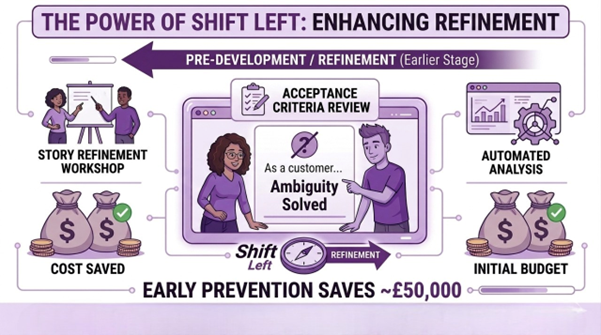
Today, some teams use structured techniques, such as acceptance criteria reviews, story refinement workshops, or automated user story analysis tools, to flag vague language like real-time, user-friendly, or scalable.
These small checks at the beginning of the process can prevent much larger problems later.
Take a moment to think about your own backlog.
How many stories contain phrases like “real-time,” “intuitive,” or “fast performance”?
Each one could represent a hidden gap between what is written and what is expected.
And those gaps rarely reveal themselves until the team has already invested weeks of effort.
The Choice You Face
Every project faces the same choice.
You can rely on human memory and the hope that everyone is on the same page. That is a strategy that works until it doesn’t.
Or you can embrace process and tools that bring a second pair of eyes to your requirements before development begins.
You can read more about the hidden cost of poor requirements and why your team might be at risk.
Because misunderstandings in software projects are not rare events. They are inevitable.
The question is not whether a misunderstanding will happen. The question is whether you will catch it in minute one or sprint six.
So, ask yourself one simple question:
Are you willing to bet £50,000 that your team’s definition of “notifications” matches your stakeholder’s?
Comments (4)